
The science
Your skin keeps things out. That is the whole problem.
A technical record of the device and the three ampoules: what is specified, how each figure is stated, and what re:tones has not measured. Read the conventions first, then the mechanism, then the ledger.
Specifications · formulations · provenance
Units and conventions
- Concentration
- Stated in ppm and as percent by weight. 10,000 ppm = 1%. Figures are quoted at the value the supplier states, not rounded for effect.
- Length
- Needle diameter in micrometers (µm). Penetration depth in millimeters (mm). 1 mm = 1,000 µm, so a 1.0 mm setting is 125 times the needle's own diameter.
- Depth
- The collar is continuous. Marked positions are labels on a range, not the only settable values.
- Intensity
- A separate axis from depth. It sets stroke rate, not how far the needle travels.
- What a concentration is
- The amount present in the sealed vial. It is not a statement about how much crosses the barrier, and nothing on this page converts one into the other.
The barrier, and why it wins
The outer layer of your skin is a barrier. Its job is to keep things out. It is the reason you can swim without absorbing the pool.
Which means it does not care what your serum cost. An expensive active and a cheap one meet the same closed door.
So most of what you pat on stays on top. It dries. It wipes off. It ends up on your pillow.
A filter, not a door.
This is not a flaw in one product. It is the condition every bottle on your shelf works under. Most of them never mention it.
Why the barrier is built this way
The stratum corneum is not a defect to be defeated. It is the reason a human body holds roughly sixty percent water while sitting in dry air, and the reason a swimmer does not absorb a pool. Dead corneocytes are packed flat in a continuous lipid matrix, and that arrangement is tuned for one job: letting almost nothing through in either direction.
Everything difficult about topical skincare follows from that. A molecule does not fail to cross because the formula was cheap. It fails because the tissue is doing exactly what kept the organism alive. Any honest account of a serum has to start by admitting the barrier is winning by design, and that a better formula competes for the same three doors as a worse one.
The barrier is not failing. It is working.
Where things actually stop
- The barrier Outer layer Dead, flat cells packed tight. Most of what you apply stops right here.
- Under it Living epidermis Live cells. The dead layer above them is the obstacle.
- Deeper Dermis Collagen and elastin sit at this level.
- Deepest Fat layer Out of scope for any cosmetic device.
No measurements here. Skin varies by person and by area, so these are positions, not figures.
Depth, drawn true to scale
Published thickness for facial skin on one true linear scale, with the 0.5 to 1.5 mm dial travel drawn against it at that same scale. Every anatomical figure is a group mean from a named study and describes nobody's skin in particular.
Three ways in, and why two of them fail
There are only three ways across that outer layer. Every serum ever made is competing for them.
One winds between the cells, through a matrix of fat. It is long, and it is fussy about what it lets through.
One goes straight through the cells. That means crossing water, then fat, then water again. Very few molecules manage all of it.
One uses hair follicles and sweat ducts. That route is fast, and it is almost nowhere.
Reformulating changes how well a molecule handles those three. It never adds a fourth.
A better formula competes for the same three doors.
The four ways across
Three routes exist through an intact barrier. Each is hard for a different geometric reason. The fourth is the one a needle opens.
What a nano-needle actually does
Absorption does not push product in. It opens temporary channels through that outer layer. The formula then travels a road that is briefly open, instead of arguing with a closed one.
The needle is 8 µm. Depth is a separate control, from 0.5 to 1.5 mm, and the collar has no clicks or stops. Which means you set it where you want it and nowhere else.
Intensity is a third control, with six settings. Depth is how far. Intensity is how hard. You never adjust both with one dial.
8 µm is finer than molding holds, so the array is not molded. It is made the way semiconductor parts are made, and the device page prints the process, the tip angles and the surface.
You set the depth. Nothing sets it for you.

Micrograph conditions
- Instrument
- Scanning electron microscope
- Accelerating voltage
- 5 kV
- Vacuum mode
- High vacuum
- Probe current
- Standard
- Scale
- The plate the manufacturer supplied carries the instrument's own 10 µm bar. Measured against that bar, that plate's frame is about 58 µm across. The view printed here is a closer one of the same array and carries no bar of its own
- Magnification
- Not published. The figure printed on the supplied plate does not agree with that plate's own scale bar, so we did not carry it over. A magnification is only true at one reproduction size, and this frame is resized by your browser. A scale bar stays true at any size, which is why the scale above is given as a field width
- Specimen
- PRO-5D Nano array as supplied. No conductive coating was applied for imaging, and the image has not been retouched beyond cropping and resizing for the web
- Provenance
- Plate supplied by the manufacturer, and the copy we hold is a low-resolution crop, which is why the field width above is given as an approximation. re:tones did not operate the instrument.
Where the Tap Pen sits among absorption devices
Absorption is a category, not one technique. These four behave nothing alike. The category gets judged as if they were the same thing.
The Tap Pen is a cosmetic device, not a medical one, and not a substitute for a clinical procedure. Depth and needle diameter are separate specs. The collar sets how far the array travels. The 8 µm figure is the PRO-5D Nano needle itself. The PRO-R Nano needle is 15 µm.
What this is not
Precision about category matters more than enthusiasm. The Tap Pen is a cosmetic device. It is not a prescription treatment, and it is not a clinical procedure performed by a practitioner.
It is also not an injection. An injection deposits a measured volume into tissue at a known depth. This opens temporary channels through the outer layer and lets an ampoule meet them. Those are different mechanisms with different consequences, and conflating them would be the easiest way to overstate what the device does.
Nor is it a dermaroller. A roller enters at an angle as the drum turns, so entry and exit are not vertical, and the needle is typically an order of magnitude wider. The comparison table above puts the published figures side by side rather than describing the difference in adjectives.
Cosmetic device. Not medical, not clinical, not an injection.
Every length on one axis
A needle 8 µm across travels up to 1,500 µm. Those two figures cannot share a linear axis, so this one is logarithmic.
Cross-sections at one scale
The same comparison drawn as real circles instead of positions on a line, so the difference is seen rather than asserted. Two of the four figures are device specifications and two are published reference values.
What happens after the channel opens
The opening is temporary. Skin begins closing it immediately, and the sequence is the ordinary wound response operating at a very small scale: the channel narrows, the surface re-seals, and the outer layer returns to doing its job.
re:tones has not measured how long that takes for this device, and no figure for it appears anywhere on this site. Published values for microchannel closure vary widely with needle diameter, depth, skin site and measurement method, which is exactly why quoting one as though it applied here would be misleading. What can be said without a measurement is the shape of the thing: the window is short, it is why the ampoule is dispensed on contact rather than applied afterwards, and it is why the cadence is once a week rather than daily.
The window is short. That is why the ampoule arrives during it, not after.
How long the barrier stays open
There is a published human answer to this, and it is worth printing even though it was measured on needles many times wider than these. One study, its own figures, and a plain statement of why they are not a specification for this device.
Coupled, not sequential
Most absorption routines are two actions. You needle. Then you apply. The gap between them is different every single time, and the channel starts closing the moment it opens.
The Tap Pen releases its paired ampoule at the moment the needle meets skin. The device and the ampoule are physically coupled. Timing stops being something you have to get right.
The formula and the road arrive together.
The depth system
- 0.5mm The shallow end. Where to start.
- 0.75mm Still shallow.
- 1.0mm The middle of the range.
- 1.25mm Past the middle.
- 1.5mm The deep end. As far as the collar goes.
The collar is continuous, not clicked. You set anywhere between 0.5 and 1.5 mm. The marks are positions on that range, not stops. Intensity is a separate control with six settings. Start shallow and work up.
The depth range against skin, with the ampoules keyed to it
Linear, so the distances are the real distances. At that scale the barrier is under five pixels wide, which is why the first 100 µm is redrawn underneath at fifteen times the size.
Three controls, and none of them move each other
There are three things to set before a session, and they are set in three different places. Depth is the collar on the body, and turning it moves the needle out or back in. Flow is a ring on the cartridge, and it sets how much ampoule the tip releases. Intensity is the button on the body, six levels, with the level shown on the on-body display so it is never something you have to remember.
None of the three reads another. Turning intensity up does not move the collar, and it does not change what the cartridge releases. Moving the collar does not change the level on the display. Each control does one thing, and it keeps doing that one thing whatever the other two are set to.
Three settings. Three places. No shared axis.
Fusing controls is the cheaper arrangement and the easier one to sell, because one dial that moves everything needs only one label. The cost is that every change becomes a trade. You ask for more of one thing and you accept more of another, whether or not the second one was what you wanted.
There is also an arrangement in which flow does not exist as a control at all. If the device does not carry the formula, the amount on the skin is whatever was applied beforehand, so there is nothing on the device to set. Putting the ampoule inside the cartridge is what turns that into a position on a ring.
The three axes, and where each one is set
- Depth
- The collar on the body. 0.5 to 1.5 mm, continuous. No clicks, no stops, and it stays at the position you leave it at.
- Flow
- A ring on the cartridge. Three detented positions. It sets how much ampoule the tip releases, and it sits on the part that holds the formula.
- Intensity
- The button on the body. Six levels, stepped one at a time, shown on the on-body display. It changes the rate, not the distance.
- How the three interact
- They do not. No control is derived from another, so changing one leaves the other two where they were.
- Where the formula sits
- Inside the cartridge before the session starts, not on the skin waiting for a way in.
Three controls that do not talk to each other
Depth, flow and intensity are three separate physical parts with three different characters. The last panel is the unusual bit: each one changes its own output and neither of the other two.
A position, not a preset
The depth collar is continuous. It does not click, it does not stop at the marked values, and it stays where it is left. The numbers printed around it are labels on a range, not the only places the ring can sit.
A stepped dial makes a smaller promise. It offers a list, and any depth you want has to be rounded to the nearest item on it. Skin does not arrive in five sizes. It is thinner at the eye than on a cheek, it differs between two people of the same age, and it differs on one person between a first session and a tenth.
Continuous means the setting is the position you picked rather than the closest one a menu allowed, and it means the position is yours to keep. If 0.8 mm is where you work, the collar sits at 0.8 mm, because nothing pulls it to 0.75 or to 1.0.
A menu rounds you to its nearest answer.
The two controls you turn by hand behave in opposite ways, and that is deliberate. Flow clicks, because three positions can be counted by feel and you should be able to find the middle one without looking. Depth does not click, because a range cannot be counted. What you give up is the click. What you get back is every value between the marks.
The formula is loaded into the tip
The cartridge comes off the device, the ampoule goes into it, and it seats back on with a push. The formula is inside the tip before the first tap, and it is released at the moment the tip meets skin.
The ordinary arrangement is two actions in an order. You needle, then you apply, and the interval between them is a different length every time. Loading the tip removes the second action, and the interval with it.
It is also what makes flow a setting at all. Because the tip holds the formula, the amount that comes out is a position on a ring rather than a consequence of how much you poured into your hand.
The tip is the reservoir, not the skin.
None of that is a statement about how much of an ampoule crosses the barrier. Loading the tip changes when the formula arrives and how it is metered. What happens after it arrives has not been measured by re:tones, and the claims ledger at the foot of this page leaves that row open.
Device specification
- Platform
- re:tones 5D Nano-Needle Array / TDDS Platform
- Needle diameter, PRO-5D Nano
- 8 µm
- Needle diameter, PRO-R Nano
- 15 µm
- Needle fabrication
- MEMS. Photolithography and deep reactive ion etching, not molding. Stated by the manufacturer
- Needle surface
- Amorphous silicon nitride, about 120 nm, applied by vapor deposition. Stated by the manufacturer
- Depth range
- 0.5 to 1.5 mm, continuously adjustable
- Depth control
- Collar dial, no clicks
- Intensity
- Six settings, separate from depth
- Ampoule delivery
- Released at the moment the needle meets skin
- Cartridges included
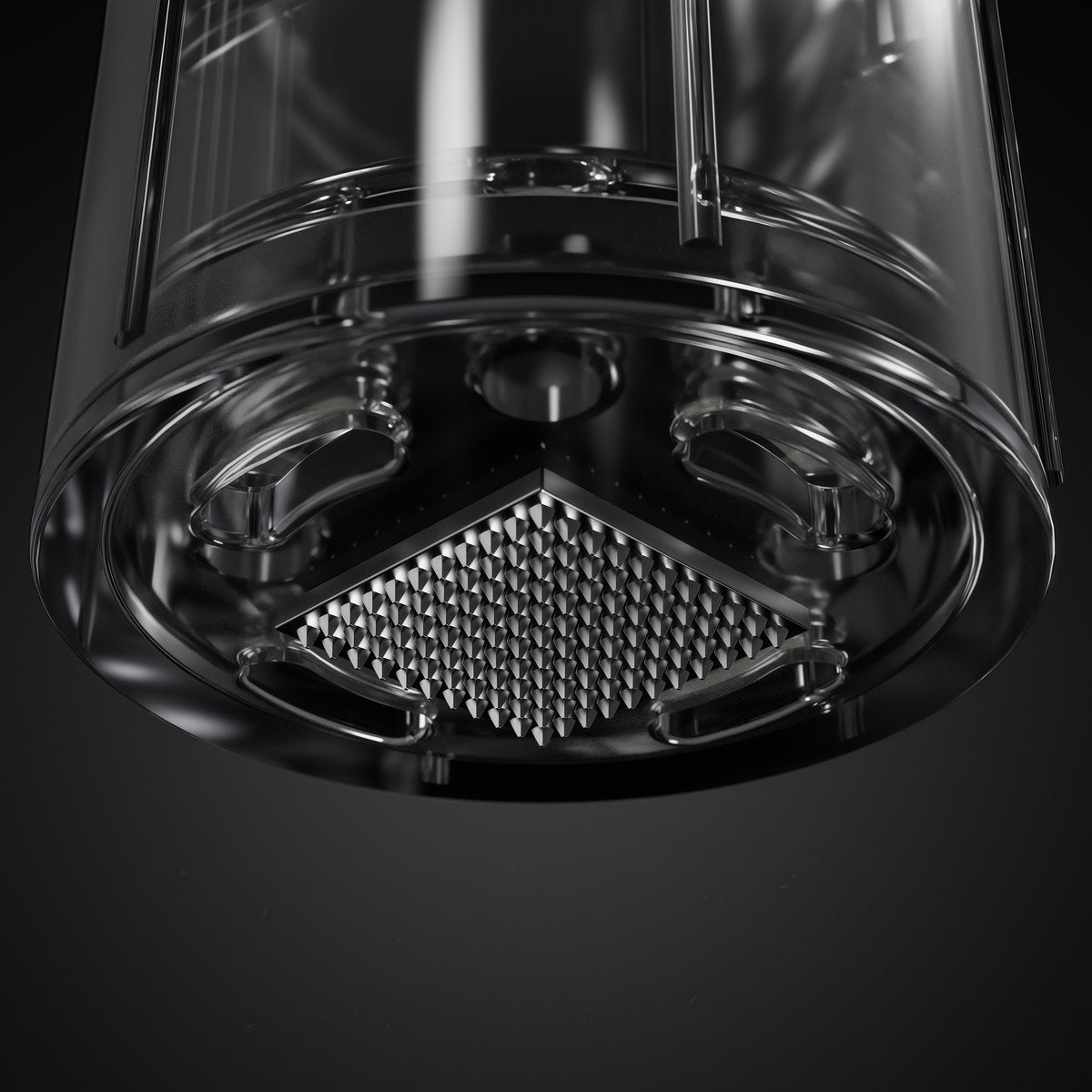
- Three: two PRO-5D Nano and one PRO-R Nano. PRO-5D Nano, square plate, 8 µm lattice. PRO-R Nano, round plate, 15 µm needle
- Cartridge life
- Sterile, single use. A fresh one each session
- Cartridge nose
- A 50 µm neck, 0.8 mm behind the tip, that every dose passes
- Cadence
- Once a week
- Intensity indicator
- On-body, shows the setting
- Body
- Brushed aluminum
- Colors
- Purple, Pink
- Origin
- Made in South Korea. Sold by Idenbrick LLC, United States
- Classification
- Cosmetic device
- Still to be published
- Needle count per array, battery capacity, charge time, weight, and the material under the needle surface
Two cartridge geometries
Both ship in the box. They are not interchangeable.
PRO-R Nano is a round plate on a heavier needle. It is the forgiving one, and the one to start on while you learn pressure and pace.
PRO-5D Nano is the square plate, set at 45 degrees, with the 8 µm lattice. It is the everyday one.
Geometry is not decoration. A round plate meets skin evenly from any angle. That matters while your technique is still uneven.
A square plate tiles cleanly across a flat area. That matters when you work across a cheek.
Both are sterile. Both are single use. A fresh one each session.
One cartridge, one session
Sterility is not a property a cartridge holds. It is a state it can only leave, so the track has no return leg.
What the plate outline changes
Circles cannot cover a plane and squares can. That is the whole of what the outline of a cartridge plate decides, and it is a fact about shapes rather than a measurement of anything this device did to skin.
A session, start to finish
- Cleanse and dryStart on clean skin with nothing on it. No actives, no oils, no makeup.
- Fit a fresh cartridgeOne per session. They are sterile and single use, so a used one goes in the bin.
- Set the depthStart at 0.5 mm. Work up over sessions, not inside one.
- Load the ampouleThe device releases it on contact. There is no separate application step.
- Tap, do not dragShort vertical passes, one small area at a time. Dragging is what leaves marks.
- Stop at the schedule, not the feelingOnce a week. More is not faster.
- Leave it aloneNo actives, no acids, no retinoid, no makeup for the rest of the day.
- Sunscreen tomorrowAnd the days after. This one is not optional.
Formulated for an open channel
An ampoule built for an open channel is a different brief from one built to sit on a surface. Two things change.
First, the format has to stay closed. You are applying to a barrier you just opened on purpose. A pump does not. It draws air, and it holds residue in the nozzle. So the format is crimp-sealed medical glass, opened once, by you.
Second, the concentration has to be worth the trip. All three ampoules are 50 mL in the same vial. The figures below come from the manufacturer's own ingredient statement.
You cannot open skin and then open a pump.
The three ampoules
- Pore Tightening
- Niacinamide 210,000 ppm (21%). Also adenosine 400 ppm, rh-oligopeptide-1, sodium DNA.
- TXA5 Brightening
- Tranexamic acid 50,000 ppm. Also niacinamide 20,000 ppm, ascorbic acid, glutathione.
- Wrinkle Peptide
- Acetyl hexapeptide-8 500 ppm. Also adenosine 400 ppm, copper tripeptide-1 and palmitoyl pentapeptide-4, both at trace.
- Format
- 50 mL crimp-sealed glass vial, aluminum crimp, rubber septum, clear flip-off cap
- Origin
- Developed and made in South Korea
What each ingredient is
- Niacinamide
- Vitamin B3, a small water-soluble molecule at 122.1 g/mol. One of the most widely used and most studied actives in cosmetic formulation, valued because it is stable, well tolerated at high concentration, and compatible with almost everything else in a formula. It carries the 01 ampoule at 21% and appears again at 2% in the 02 ampoule.
- Tranexamic acid
- A synthetic derivative of the amino acid lysine, 157.2 g/mol. Originally a pharmaceutical, now used topically in tone-focused cosmetic formulation. It leads the 02 ampoule at 5%.
- Acetyl hexapeptide-8
- A six-amino-acid peptide, 889.0 g/mol, acetylated at one end and amidated at the other. Used in expression-line formulation. It leads the 03 ampoule at 500 ppm, a level set by the ingredient class rather than by ambition.
- Adenosine
- A nucleoside, 267.2 g/mol, present in every living cell. It sits at 400 ppm in both the 01 and 03 ampoules.
- rh-Oligopeptide-1
- A bioidentical peptide produced by recombinant expression rather than extraction. Present in the 01 ampoule; the concentration is not published.
- Sodium DNA
- A salt of deoxyribonucleic acid, used in formulation as a hydrating and film-forming ingredient. Present in the 01 ampoule; the concentration is not published.
- Ascorbic acid and glutathione
- Both present in the 02 ampoule. Neither concentration is published, so neither is drawn at any size in the charts on this page.
- Copper tripeptide-1 and palmitoyl pentapeptide-4
- Present in the 03 ampoule at trace levels, 1e-6% and 1e-7%. At those levels they are label dressing. re:tones does not build a claim on either one and neither is drawn at any size.
Why these were chosen for an opened channel
- Water solubility
- Every lead active here is water-soluble. An ampoule meeting a freshly opened channel is meeting an aqueous environment, and an oil-phase active would be the wrong tool for it.
- Molecular size
- The four small molecules sit under the 500 dalton heuristic; the two peptides sit well above it. That spread is the reason the plate on this page exists. A formula that only contained small molecules would not need a channel as badly.
- Stability in a sealed vial
- Ascorbic acid in particular is famously unstable once exposed to air and light. A crimp-sealed vial opened once is a format that suits an ingredient like that, which is part of why the format was chosen and not simply how it looks.
- Tolerance at concentration
- Niacinamide at 21% is a high figure by any standard. It is possible because the molecule is well tolerated at concentration, not because higher is automatically better.
- What this section is not
- The above describes what these ingredients are and why this formulation reaches for them. It is not a statement about results, and nothing here says what any of them will do for your skin.
What each ampoule actually carries
The six actives span three decades. On a linear axis the two smallest would be invisible, which is the point: a concentration is a dose, not a rank.
Percent and ppm are two rulers for one quantity
Three linear rulers at ×1, ×100 and ×1,000. Four of the eight figures on this page fall inside 3.6 px of the percent one, which is the whole reason the cartons are printed in ppm.
Molecule size against the barrier
A rough size gate from the permeation literature, with every active in the range plotted against it.
Where the reference figures come from
- Hair diameter
- Typical scalp hair is 50 to 100 µm, with about 70 µm commonly cited as the average. The full human range is roughly 17 to 180 µm, and it varies with ancestry. Used here for scale only.
- Pore diameter
- Contested, because two definitions are in use. Pore openings are often given as 40 to 100 µm; visible facial pores, which are shallow surface depressions rather than openings, are usually given as 250 to 500 µm. This site uses the narrower figure, which is the conservative one for any comparison against a needle.
- Stratum corneum thickness
- Commonly given as 15 to 20 µm on facial skin, varying by site and by person.
- Status
- All three are general literature values, not re:tones measurements. They are marked as reference figures in the claims ledger and are used to give a sense of scale, never as a basis for a claim about this product.
A figure, or nothing
There is a shorter, warmer version of this page that we chose not to write. It would say the device works on lines, that it wakes something up underneath, that skin rebuilds itself afterwards. Those are the easiest sentences in this category to write, and every one of them is absent here on purpose.
A claim does not only describe a product. It can change what the product legally is. Say that a device acts on the living biology under the surface and you have not written a bolder sentence about the same object, you have moved it into a different category with a different set of rules attached to it. The wording is enough to do that on its own. The hardware never has to change.
So the copy stays on the side we can account for, which is what the device does mechanically. A needle diameter stated in micrometers. Temporary channels through the outer layer. A collar you set by hand between 0.5 and 1.5 mm. An ampoule released at the moment of contact. Each of those is a fact about an object, traceable to a specification or to the thing in your hand.
What follows inside skin is not ours to narrate. We have not measured it, and we are not going to fill the gap with language while we wait. That is why there is no efficacy percentage on this site, no before and after, and no account of what your skin is doing in the weeks after a session. The grades and the ledger below list what is missing rather than hiding it.
The wording is enough on its own. The hardware never has to change.
What is printed instead is the rest of this document. Every figure on this site carries the thing it rests on and the grade that goes with it. 8 µm and 15 µm for the two cartridge geometries. 0.5 to 1.5 mm of collar travel, set by hand. 210,000 ppm of niacinamide printed next to the 21% it converts to, because those are two rulers for one quantity. None of it is decoration. Each figure is a claim, and each one is in the ledger below with its basis beside it.
It is much easier to write a phrase that sounds like a specification than to print one. Surgical grade stainless steel is the type of phrase we mean. It reads like an engineering term and it is not one. It names no alloy, no composition, no supplier and no lot, so nobody can check it and nobody can compare two products by it. From the phrase alone there is no way to know whether two things carrying it are made of the same metal. It is not on this site, and neither are its relatives. Where the alternative is language of that kind, we print the figure or we print nothing.
The rule costs us as much as it earns. The needle surface is now named, because the manufacturer has stated it in writing, and it carries the lower grade that a written statement earns. The rest of the cartridge is still not named by grade, and it will not be until the manufacturer states it in a form we can print and stand behind. Needle count per array, battery capacity, charge time and weight are absent for the same reason, listed as outstanding in the specification above and graded in the ledger below rather than estimated into existence. Nine measurements are specified in our brief to the manufacturer and not one of them has come back. Further down this page, What we have not measured yet prints the exact sentence each of those reports would let us write, with the blanks still showing.
Stated plainly, that is the standard this document is written to, and it is a standard we set for ourselves rather than a comment on anyone else. A figure appears here only with its source attached, and a sentence that needs a figure we do not have does not appear at all. It is a slower way to write a page, and it is the only version of this one we can defend line by line.
Evidence grades
- Substantiated
- Traceable to a manufacturing specification, a supplier ingredient statement, or the physical product in hand.
- Manufacturer statement
- Stated in writing by the engineering team that specifies and builds the device. Not a third party test, and not verified by re:tones. Used for how a part is made, and never for a result on skin.
- Qualitative only
- Stated in words because no figure has been measured. No number is implied.
- Reference figure
- A general value used for scale on a comparison, drawn from published literature rather than from re:tones testing. Marked wherever it appears.
- Not published
- The manufacturer has not supplied it. Listed here rather than estimated.
- Not claimed
- Deliberately absent. re:tones has run no consumer panel and no clinical study, so no efficacy percentage, no absorption multiple and no time-to-result appears anywhere on this site.
Claims ledger
Every figure re:tones uses, what it rests on, and its grade. Rows that are not yet substantiated stay on the list rather than being quietly dropped.
What we have not measured yet
Nine measurements are specified in our test brief to the manufacturer. Not one of them has come back. Each row below prints the exact sentence that report would let us write, with its blanks still showing. Until a figure and a report number both exist, that sentence appears nowhere else on this site.
The same brief also asks for laboratory work that is not written for a storefront. Those reports stay in our engineering file, and no sentence on this site rests on them.
Terms used on this site
- Outer layer
- The top of your skin. Dead, flat cells packed tight. The barrier most topicals never cross.
- Temporary channel
- The opening the device makes through that layer. It closes on its own.
- TDDS
- Transdermal delivery system. The category of technologies for moving something across the skin barrier.
- Micron (µm)
- One thousandth of a millimeter. The unit the needle is measured in.
- ppm
- Parts per million. A finer unit than a percentage, used on the cartons because it makes small concentrations legible.
- Nano-needle
- Here, a needle measured in single-digit microns. Not a nanometer-scale structure.
- MEMS
- Micro electro mechanical systems. The fabrication class used for semiconductor parts, and for this needle array.
- Crimp seal
- An aluminum collar swaged over a rubber septum. Opened once, not resealable, which is the point.
Molecular weight against the 500 dalton rule
Ten published weights on a log dalton axis, and three named ingredients with no weight to plot at all. A size rule can only sort what has a size.
What 50 mL actually holds
An 88% water base is 44 g. The four named actives together come to 257.5 mg, about a quarter of a gram, which at true scale is a 0.87 px line. The arithmetic is on the plate.
You already bought the other half.
Shop the Tap Pen