
Absorption
Most of what you put on your face never gets in.
The outer layer of your skin is a barrier. Its job is to keep things out. It does not care what your serum cost.
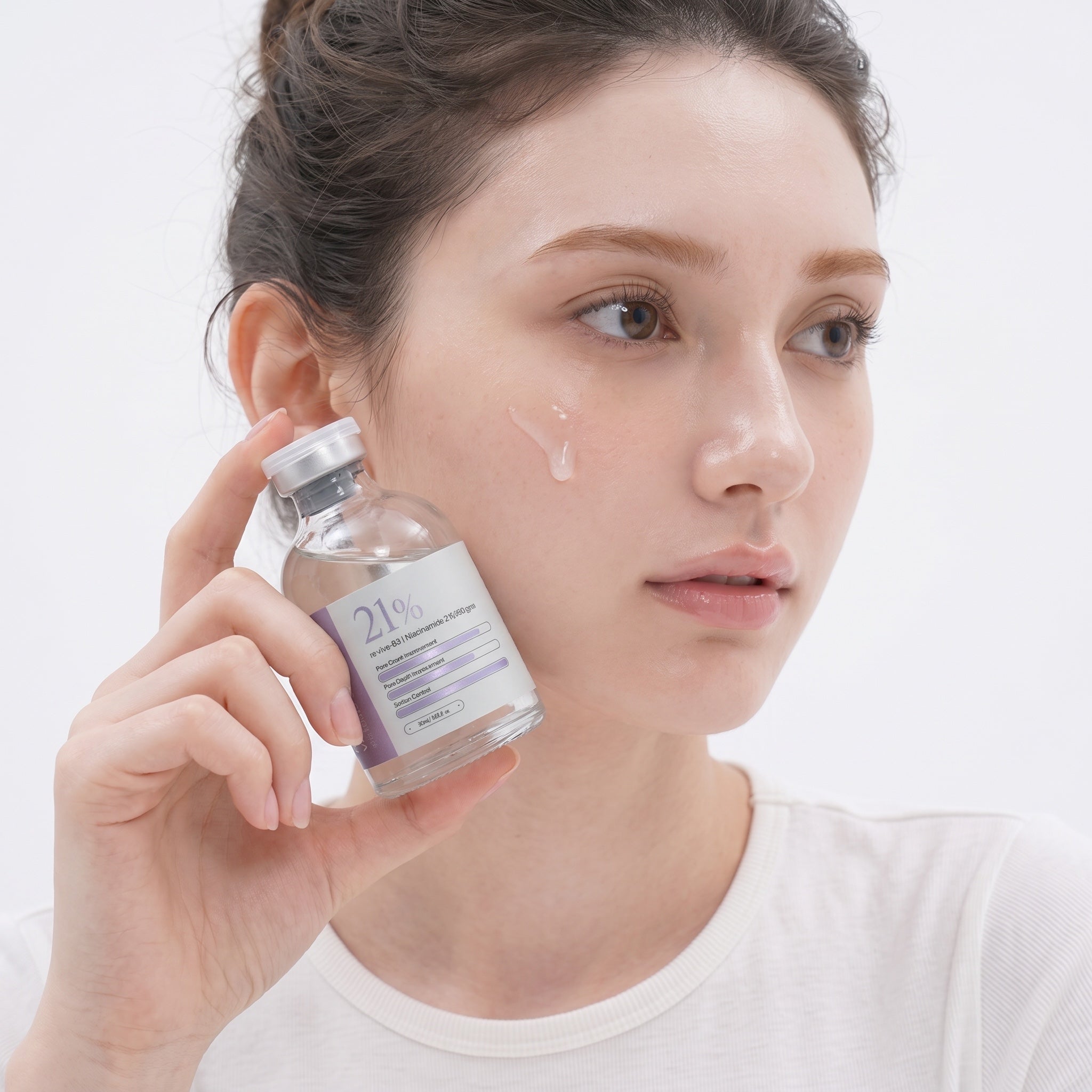
What that actually looks like
You finished the bottle. Your face looked the same.
These are the ways people describe it, when they are not trying to sound clinical about their own routine.
-
1
I did everything right for three months and I cannot tell.
-
2
There is a drawer of half-finished bottles in my bathroom.
-
3
Some of it is still on my pillowcase in the morning.
-
4
I assumed the expensive one would be the one that worked.
None of those is a story about a bad formula. All four are a story about a door.
Why it happens
The outer layer is built to keep things out.
It is a wall of flattened dead cells, and it is the reason you can swim without absorbing the pool.
In section
-
01
The wall is the last thing your skin makes
Cells flatten, die and stack into a layer whose only job is to be a barrier. It is the finished product of everything underneath it.
-
02
Size and oil decide who gets through
Small molecules that mix with oil have a route through the mortar between those cells. Most of a formula is neither of those things.
-
03
The rest dries where you put it
What cannot get through sits on the surface, dries, and comes off on a towel or a pillow.
-
04
This was never a formula problem
Smaller molecules, new carriers and better textures are real work. All of it is aimed at a wall that does not negotiate.
The barrier is not absolute and nothing here says it is. A little does get through, which is why a good serum is not useless. re:tones puts no figure on how much, because re:tones has not measured one.
What you have already tried
Everything on the shelf meets the same wall.
Several of these are worth doing and none of them is a scam. The marker beside each row is where each one stops.
A more expensive serum
Price does buy better actives, better stability and better texture. Those are real differences and you can feel some of them.
The wall does not read a price. A better formula still has to get past the same layer.
Stays on the surface
Layering, in the right order
Order matters. Thin before thick is real, and it stops one product sitting on top of the next.
Each layer still waits at the same door. Correct order does not open one.
Stays on the surface
Sheet masks and occlusion
Holding water against skin softens the outer layer, and skin looks better for it straight afterwards.
A softened wall is still a wall. Softening is not the same as opening a route through it.
Reaches into the outer layer
Steam and warm water
Warmth loosens surface oil, which makes cleansing easier and more comfortable.
Heat does not open a channel. The pore has no muscle, and the layer above it has no door.
Stays on the surface
A roller or a gua sha
Pressure moves fluid, and a face can look less puffy for a while afterwards.
It presses on the wall. It does not go through it.
Stays on the surface
The marker is a position in a drawing, not a measurement in anyone's skin. No depth on this page has been measured by re:tones.
What would have to change
A channel, and something standing ready to go into it.
Absorption opens temporary channels through the outer layer. The other half of the problem is what is waiting to use them.
The axis
15 to 20µm†
How thick the outer layer of facial skin is, as a general reference figure. That is the whole distance in question.
6settings
Intensity, set separately from the collar
We did not just make the serum. We made the road.
† Stratum corneum thickness and the depth of the viable epidermis are general reference figures for facial skin, not re:tones measurements. Every depth shown is a position the collar is set to, not a measured depth in anyone's skin. How much of anything reaches a given layer, and how long a channel stays open, are not measured by re:tones and are not claimed on this page.
What we make
Both halves, or it does not work.
Device companies sell a pen and leave you to pick a serum. Skincare companies sell a serum and hope you own a pen.

The half nobody sells you
re:tones Skin Rejuvenation Tap Pen Device
$109Two colorways, three cartridges in the box
- Tip
- 8 µm on the PRO-5D Nano cartridge, 15 µm on the PRO-R Nano
- Depth
- 0.5 to 1.5 mm, continuous, on a collar with no clicks
- Intensity
- Six settings, separate from depth
- Release
- The ampoule is dispensed at the moment the tip meets skin
- Cartridges
- Three in the box. Sterile, single use
- Classification
- Cosmetic device
What we do not tell you
- It does not treat any condition.
- We do not tell you how much more of anything gets in. We hold an internal figure, it is not substantiated, so it does not run.
- We do not tell you how long a channel stays open. That has not been measured.
- We do not claim it is painless. Sensation varies by person, by depth and by area.
- There is no re:tones trial, and there are no customer reviews yet.
What goes into the channel
-
 01 Pore Tightening
Niacinamide 210,000 ppm, which is 21 percent$39
01 Pore Tightening
Niacinamide 210,000 ppm, which is 21 percent$39
-
 02 TXA5 Brightening
Tranexamic acid 50,000 ppm, which is 5 percent$39
02 TXA5 Brightening
Tranexamic acid 50,000 ppm, which is 5 percent$39
-
 03 Wrinkle Peptide
Acetyl hexapeptide-8 500 ppm, which is 0.05 percent$39
03 Wrinkle Peptide
Acetyl hexapeptide-8 500 ppm, which is 0.05 percent$39


One thing to do
You already bought the formulas. This is the road.
Count the bottles you quit halfway. Every one of them was the half of the system with no way in.
Build the system
Put the device and an ampoule in the cart and 10 percent comes off the ampoule. There is no code to enter.
re:tones is developed and made in South Korea and sold by Idenbrick LLC in the United States. The Tap Pen is a cosmetic device, and nothing on this page is a medical claim.