
Pores
You cannot shrink a pore.
It has no muscle, so it cannot contract. Nothing you apply resizes the opening. What changes is what is sitting inside it.
The way it actually gets described
Nobody calls them follicular openings.
These are the ways people describe it, when they are not trying to sound clinical about their own face.
-
1
It looks like somebody went over my nose with a pen.
-
2
Fine in the morning. By six in the evening it is all I see.
-
3
I have bought everything with the word pore printed on it.
-
4
In photos it is the first thing I look at, every time.
All four describe the same piece of anatomy. None of them describes dirt.
Why it happens
A pore is the mouth of a shaft.
The shaft has no muscle. What changes is how much oil sits in it, and how much unlit opening you are looking into.
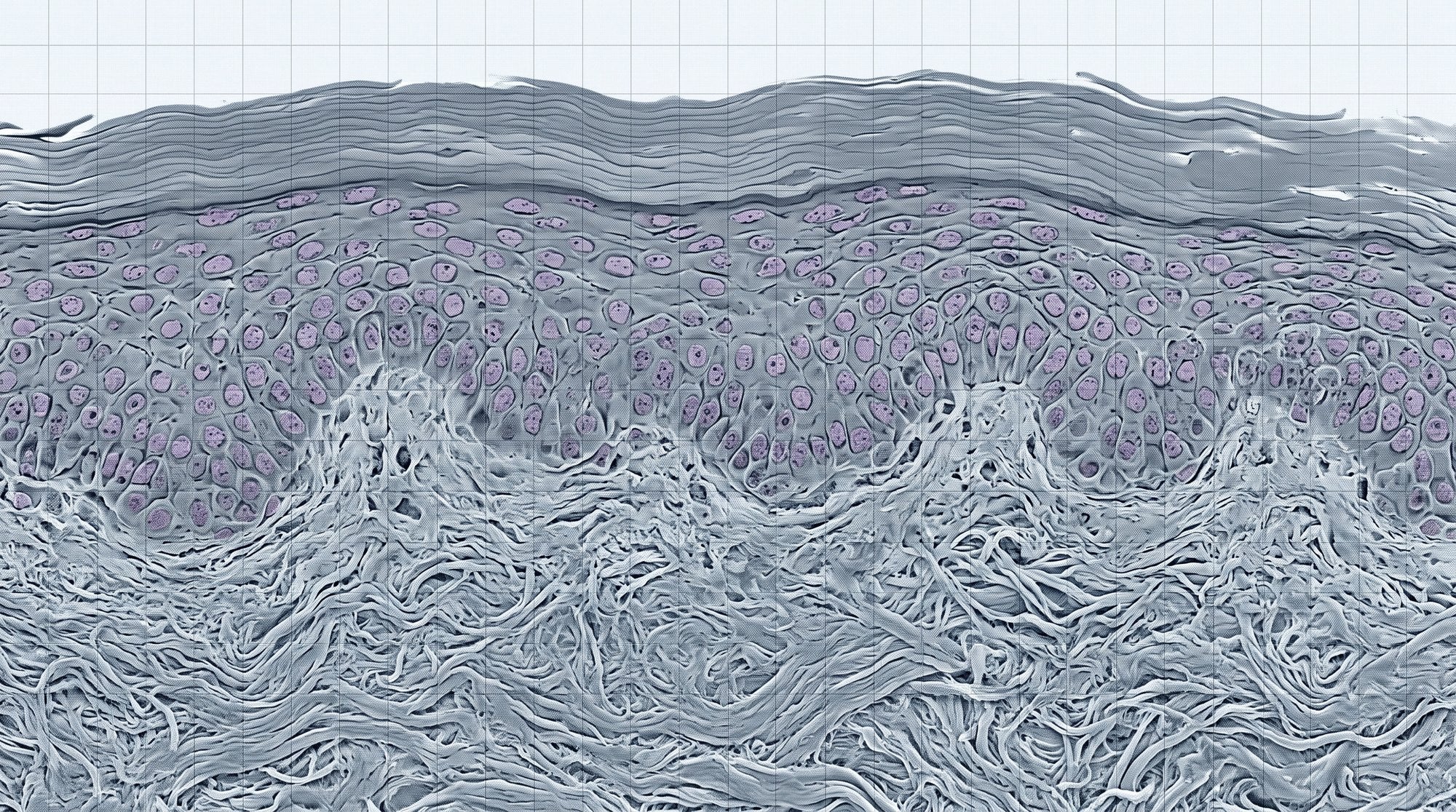
In section
-
01
It is a shaft, not a hole with a lid
A pore is where a follicle reaches the surface. There is no muscle around it, so it does not open and close.
-
02
Oil collects, and the wall gives
Oil is made down the shaft and travels up it. When more sits in there than leaves, the wall is pushed outward and the mouth reads wider.
-
03
A wider mouth is a darker mouth
The inside of a shaft is not lit. The wider the opening, the more unlit shaft you see into, and that shadow is what you are looking at.
-
04
Most nose dots are not blackheads
Gray to tan, flat, similar in size, spread evenly across the nose. That is normal oil flow made visible, and it is anatomy.
The two are worth telling apart. A real blackhead is darker, larger than its neighbors, and sits on its own. Sebaceous filaments are gray to tan, flat, similar in size, and spread evenly across the whole nose. The first can be cleared and kept clear. The second is normal anatomy and cannot be permanently removed by anything.
What you have already tried
Most of it works. It just works up here.
None of these is a scam and several are worth doing. They share one limit, and the marker beside each row is where it sits.
Scrubs and brushes
They take off loose surface cells, and skin does feel smoother straight afterwards.
Abrasion cannot enter a channel. Whatever is sitting inside the shaft is not on the surface being scrubbed.
Stays on the surface
Pore strips
They genuinely lift the cast out of the shaft. That is a real thing happening, and it is why the strip looks like that.
The shaft is still a shaft and oil is still made in it. Nothing about the opening has changed.
Stays on the surface
Cold water and toners
They change how skin feels and can take shine down for a while.
The opening has no muscle, so there is nothing there to contract. Whatever changed, it was not the size of the pore.
Stays on the surface
Washing more often
Cleansing clears the surface, which is worth doing every day.
Washing cannot reach inside a follicle. Over washing strips the barrier, which usually makes oil and texture worse.
Stays on the surface
A niacinamide serum
Niacinamide is one of the better studied actives in skincare, and most formulas stop at 5 percent for stability and cost reasons.
It still has to get through the outer layer, and that layer is built to keep things out. Most of what you pat on dries on top.
Reaches into the outer layer
The marker is a position in a drawing, not a measurement in anyone's skin. No depth on this page has been measured by re:tones.
What would have to change
Something has to get past the outer layer.
Absorption opens temporary channels through it. That is a route, and a route is not a promise.
The axis
15 to 20µm†
How thick the outer layer of facial skin is, as a general reference figure. That is the whole distance most of a serum never travels.
500µm
The outer layer the channel has to cross. That is the reason a serum alone stalls on the surfass above it.
The formula was never the weak link. The road in was.
† Stratum corneum thickness and the depth of the viable epidermis are general reference figures for facial skin, not re:tones measurements. Every depth shown is a position the collar is set to, not a measured depth in anyone's skin. How much of anything reaches a given layer, and how long a channel stays open, are not measured by re:tones and are not claimed on this page.
What we make
Niacinamide at 210,000 ppm, put where it has somewhere to go.
re:tones makes both halves. A device that opens the channel at a depth you set, and an ampoule dosed for the moment after it.

The shallow end of the dial
01 Pore Tightening Vial Ampoule
$3950 mL crimp-sealed medical glass
- Active
- Niacinamide 210,000 ppm, which is 21 percent
- Format
- 50 mL vial, aluminum crimp cap, sealed until you open it
- Paired depth
- 0.5 to 0.75 mm on the collar
- Also in it
- Adenosine 0.04 percent, rh-Oligopeptide-1, Sodium DNA
- Cadence
- Once a week
What this does not do
- It does not shrink a pore. Nothing does, and the opening has no muscle to contract.
- It does not remove sebaceous filaments. Those are normal anatomy and they come back.
- It is not a treatment for acne or for any other skin condition. That is a doctor's territory.
- The Tap Pen is a cosmetic device, and nothing here is a medical claim.
- We make no promise about your result. There is no re:tones trial, and there are no customer reviews yet.
The other half
-
 Tap Pen
8 µm tip, 0.5 to 1.5 mm collar, three cartridges in the box$109
Tap Pen
8 µm tip, 0.5 to 1.5 mm collar, three cartridges in the box$109

One thing to do
The road in is the part you have never bought.
Count the bottles you quit halfway. You already paid for product that never got in. This is the half that was missing from all of them.
Build the system
Put the device and an ampoule in the cart and 10 percent comes off the ampoule. There is no code to enter.
re:tones is developed and made in South Korea and sold by Idenbrick LLC in the United States. The Tap Pen is a cosmetic device, and nothing on this page is a medical claim.